Publication
Non-equilibrium biodiesel hydrogenation: probing near-surface atomic hydrogen by fs-TALIF
Journal of Physics D: Applied Physics
·
03 Jun 2026
·
doi:10.1088/1361-6463/ae71e3
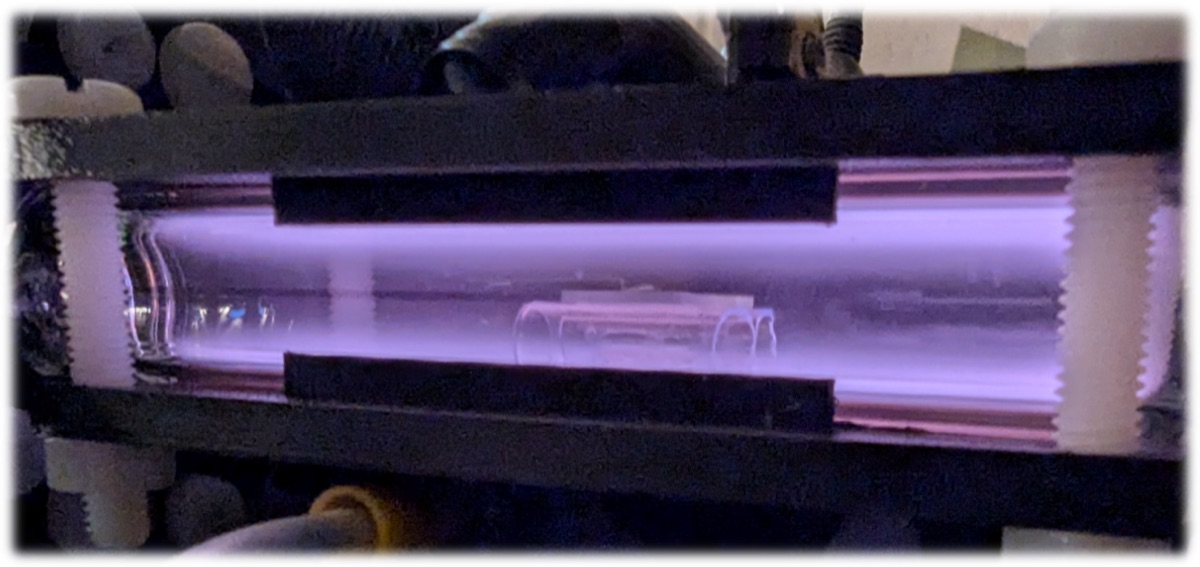
In this work, spatially and temporally resolved atomic hydrogen profiles were quantified using femtosecond two-photon absorption laser-induced fluorescence at the plasma-biodiesel interface, at low pressure and room temperature. A pronounced near-surface hydrogen depletion was observed, corresponding to an incident H-atom flux of 1.9 × 10¹⁸ cm⁻² s⁻¹, approximately four orders of magnitude higher than molecular hydrogen fluxes typical of thermal catalytic hydrogenation. Within 2 h of plasma processing, the H-atom density gradually recovered to the no-fuel baseline, indicating progressive elimination of the surface C=C bonds. With Ni catalyst addition, near-surface H density was further decreased by 50% and remained depleted throughout the plasma processing. From GC–MS measurements, it is evident that plasma processing shifted the biodiesel from an unsaturated profile to a predominantly saturated one. C18:1 fell from 37.8% in the untreated sample to trace levels in the no-catalyst case, while C18:0 rose from 38.9% to 85.5%. In the presence of Ni, unsaturated components such as C18:1, C18:2 and C20:1 were not detected and C18:0 increased slightly further to 86.6%. Kinetic modeling reveals that non-equilibrium hydrogenation proceeds via two distinct regimes: a surface-limited, self-terminating process in the plasma-only case, and a persistent first-order, H-flux-controlled process in the plasma-catalysis case. These findings establish a quantitative mechanistic link between plasma-generated H flux and hydrogenation kinetics, offering fundamental understanding of upgrading biofuels with renewable electricity and electricity-derived hydrogen.